
I explain how to set up a stable source of income from the noodle bar in Nivalis Nights. I focus on keeping ingredient costs low, making the seating as efficient as possible, and setting up staff so I can spend more time exploring Nivalis. I cover ingredient stocking, seating and pathing, staff hours, wages, hiring, noodle prices and a few extra ways to reduce costs.
Ingredient Optimisation
I stick to Noodle Soup for now.
It only requires 3 ingredients in equal amounts.
On the opposite side of the market, I find 2 vendors that sell everything I need.

I initially buy:
- 30 Chicken from the Butcher.
- 30 Onions from the Greengrocer.
- 30 Ramen from the Greengrocer.
I then interact with any cabinet in the noodle bar and put everything inside.
Problems I need to manage
- Running out of stock.
- Overstocking.
- Food spoiling.
- Stock costs.
Ingredient facts
- Ingredients with less than 2 days remaining are about half price.
- Ingredients with less than 2 days remaining will spoil overnight.
- Fresh ingredients can sometimes spoil overnight.
I buy nearly expired ingredients in the morning. They should get used during the day and save me around 50% on ingredient costs.
They will almost always spoil by the end of the day.
I buy fresh ingredients in the afternoon when possible. This reduces the chance of them spoiling overnight if they are not used.
How much should I buy?
This depends on how many seats I have and how busy the noodle bar gets.
Ideally, I want the day to end with around 1-4 of each ingredient left. This limits losses from spoiling overnight while making sure I do not run out near the end of the day.
I usually get around 3-4 rushes where every seat is filled.
With 11 stools:
11 stools x 4 rushes = 44 meals
I also get around 1-3 customers between each rush buying noodles.
I estimate around 8 extra meals.
That gives me around:
44 + 8 = 52 meals
So in the morning, I start with around:
- 52 Onions
- 52 Ramen
- 52 Chicken
At 15:00, I check my stock again and decide whether I need to buy more.
At this point, I should be around halfway through my stock, with about 26 of each ingredient remaining.
At the end of the day, I check how much I have left and make a note of it.
The next morning, I reduce the amount I buy if I had too much left over.
I keep adjusting this until I am finishing the day with around 1-3 meals worth of ingredients left.
I am now financially optimised on ingredients.
Pathing / Stools Are Amazing
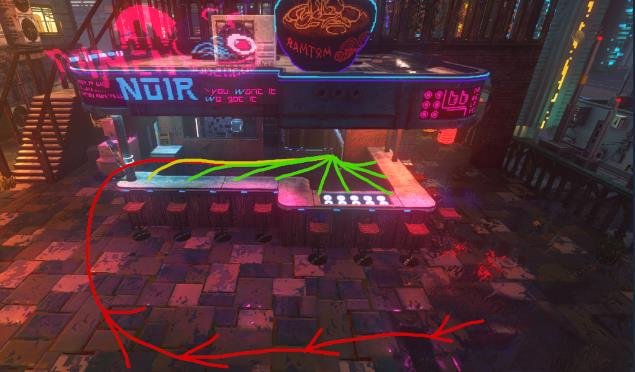
For the Noodle Bar, I consider the tables a trap.
It takes a long time for a server to reach a table and return because they have to walk around the bar.
They also need to make this trip 3 times for each customer:
- Taking the order.
- Delivering the order.
- Clearing the empty bowls.
With bar stools, the server can instead take only a few steps between the customer and the kitchen.
I have illustrated the different paths above.
As early as possible, I sell my tables and chairs.
I then buy the cheapest stools available from the furniture store on the other side of the Meridian Market.
I can fit approximately 11 stools.
That gives me 7 more stools than the starting 3.
I arrange the stools like this:
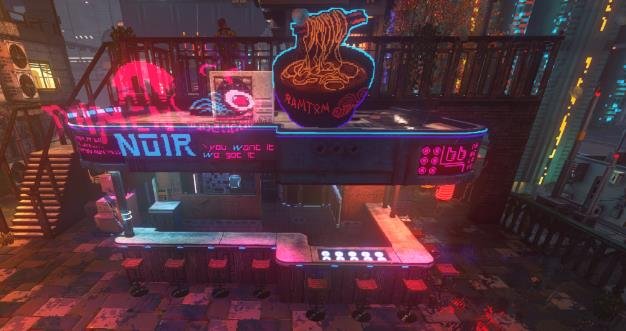
My waiter travel times are now much shorter.
This also means I need fewer waiters.
Staff Optimisation
I check my staff hours by interacting with the tablet at the entrance to the noodle bar.
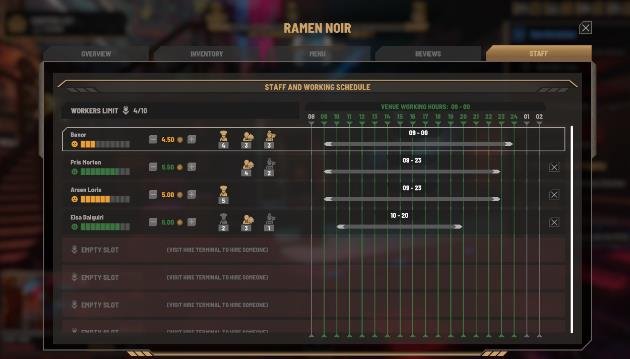
Cooks
For Noodle Soup, there are 2 cooking interactions on 2 separate machines.
I recommend having at least 2 people with cooking enabled.
I can click the chef icons to enable or disable their cooking skill.
Servers
I recommend 3 servers.
There is simply too much work during the rush.
I need around 2-3 people with the waiter icon enabled to keep up.
Cleaners
I only enable 1 cleaner.
The noodle bar needs to stay clean, but anyone cleaning has to travel a long way away from the bar.
This means they are away from cooking and serving for a good minute or two.
A dedicated cleaner can be expensive because cleaning is needed throughout the day, but the amount of mess is fairly low and infrequent.
Busy times
For me, the busy times are:
- 08:00
- 13:00 to 15:00
- 19:00
- 21:00
These times may be different for me depending on how the day develops.
I make sure I have enough staff working during these periods.
Dead times
These are the periods where there is very little for the staff to do.
For me, these are:
- 11:00 to 12:00
- 15:00 to 16:00
- 23:00 onwards
I try to reduce the number of active staff during these periods.
I can also use these times as staff changeover points, where one employee finishes and another starts.
After adjusting the schedule, I can see whether I need additional staff.
I can also see if any staff are over-skilled or are not a good fit for the hours or tasks I have available.
Hiring The Right People
To hire new staff, I find the job board.
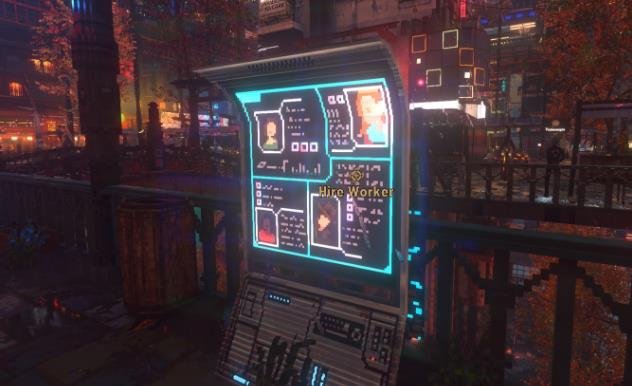
This screen shows everyone currently available to hire.
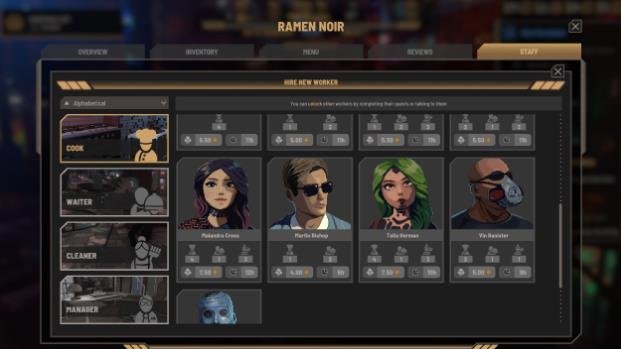
I mainly look at:
- How many hours they want to work.
- Which jobs they can do.
There are a few important things to know:
- I pay staff by the hour.
- If I give them exactly the number of hours they want, they are happier to work for less pay.
- If I make their working hours longer or shorter than their preferred amount, I need to pay them more per hour to maintain the same happiness.
- Staff with more or higher skills cost more per hour.
If I want a team that stays active throughout the day, I look for staff requesting 10+ hours.
If I want to optimise wages and save an hour or two of wages in the middle of the day, I hire staff who request fewer hours and use them for part-time shifts during busy periods.
Generalist employees with all 3 skills are expensive.
I avoid hiring generalists whenever possible.
I can build a team of 3-4 staff with both chef and waiter skills active.
Staff usually move towards the nearest available task, so this can reduce waiting and travel time.
It also helps prevent staff from standing around with nothing to do.
This setup costs more than using dedicated single-skill staff, so I reduce the number of active and overlapping staff to compensate.
I spend some time adjusting working hours because the game is paused while I do it.
I increase and decrease their hours and watch how their happiness changes. Then, I try to give each employee the exact hours they want.
This lets me lower their pay slightly while keeping them happy.
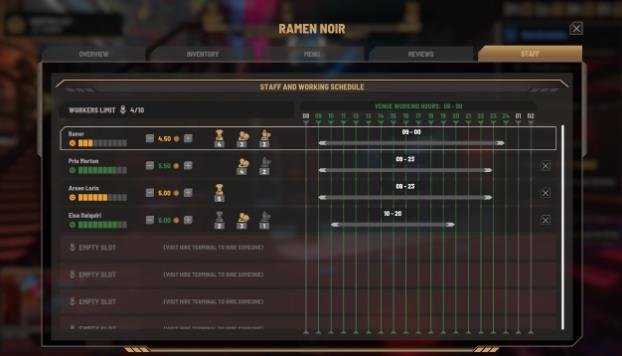
This is important because I pay that hourly rate for every hour they work.
The cost adds up quickly. I also replace staff who are unnecessary or over-skilled for the roles I need.
For example, if I have a 3-skill generalist who I only use for cooking, I can replace them with someone who only has the chef skill.
This can save a significant amount on their hourly rate.
If I have a waiter who becomes unhappy when I increase their working hours and needs higher pay, I replace them with someone looking for 10+ hour shifts.
This lets me keep wages lower while maintaining the same happiness level.
Staff skill levels
I am currently unsure how much higher skill levels improve performance.
Staff do level up their active skills over time.
I assume higher skills mean faster interaction speeds, but I have not noticed a huge difference yet.
This may change with future updates and patches.
Further Optimisations
Price of Noodle Soup
I can increase the price of Noodle Soup using the tablet by the entrance.
If every seat is filled during every rush that day, I increase the price by +1.
I continue doing this every day until I start seeing empty seats.
When that happens, I lower the price by -1.
If I can maintain a 4-5 star rating, I should be able to gradually reach a much higher price than the default.
Opening at 09:00
If I have no staff scheduled for 08:00-09:00, the shop will not open until 09:00.
I use this time to restock accurately in the morning before the busy period starts.
Closing early
If no one is working from 23:00 onwards, the shop will close.
This gives me an extra hour to collect all leftover stock and sell it back to the merchants.
Doing this can save a lot of money because I can avoid almost all food spoilage losses.
Spoiled ingredients
I clean out spoiled ingredients as soon as possible.
Spoiled ingredients can potentially cause other ingredients to spoil.
I can sell spoiled ingredients to a vendor for 0 lims.
Managers
Managers are okay, and I expect them to improve with future patches. The biggest reason I avoid them early on is their stock management.
They will constantly spend money buying stock and then spend most of their shift standing around.
I am better off restocking the noodle bar myself until I have built up enough wealth or I simply get tired of managing the stock.
I would consider hiring a manager once I have over 1000 lims. I still need to keep around 1000 lims available so the manager can always buy ingredients when needed.
Tables and chairs
Even though I consider tables and chairs inefficient early on, I can eventually expand to them.
The problem is that I need many additional waiter staff to support the extra seating.
The additional staff costs can offset the extra profit from the additional customers.
I recommend maxing out the stools first.
After that, I experiment with tables and chairs and see if the additional seating is profitable for my noodle bar.